研究に基づくアプローチ
What the research says
I choose approaches that are backed by research, and I'll always be honest with you about how strong the evidence is. Here's a summary in plain English, with links to the studies.
 Strong evidence
Practising real tasks works best
Therapy that focuses on the actual everyday tasks your child wants to do, such as writing, dressing or riding a bike, with clear goals, has the strongest support. A large review of children's OT rated goal-directed training, the CO-OP approach and task-specific practice as "do it".
Novak & Honan, 2019 · Blank et al., 2019
 Strong evidence
Parents make the biggest difference
Coaching parents, family-centred care and home programmes are all rated as effective. That's why I spend time showing you simple activities that fit into your normal routine, so progress continues between sessions.
Novak & Honan, 2019
 Strong evidence
Handwriting needs regular practice
Handwriting improves most when children actually practise writing with guidance, rather than through hand exercises alone. Research suggests programmes work best when they run for around 20 sessions or more, so expect steady progress, not a quick fix.
Hoy, Egan & Feder, 2011 · Novak & Honan, 2019
 Good to know
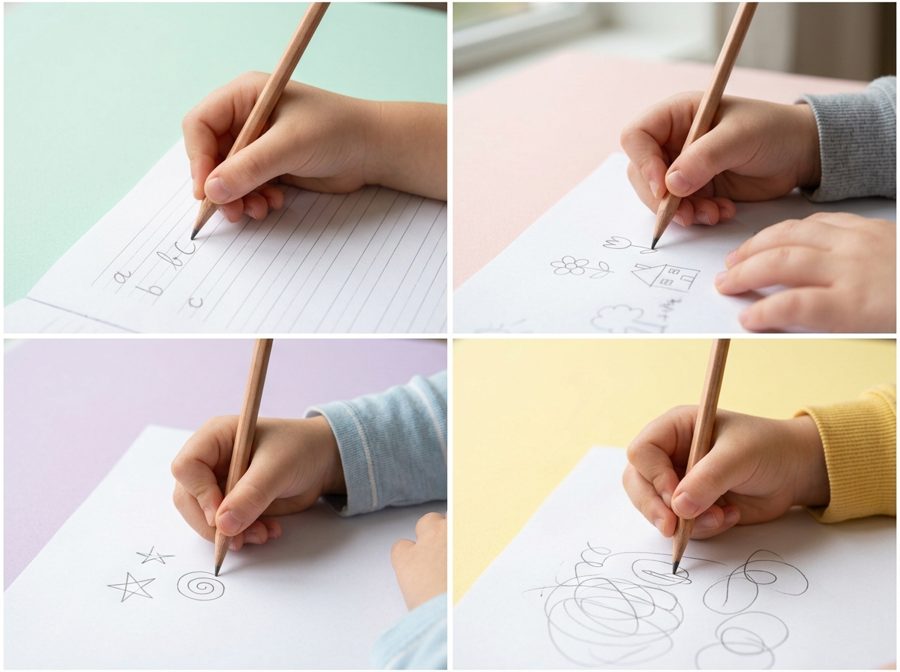
There's more than one "right" pencil grip
A study of Year 5 children found that four common pencil grips gave the same speed and neatness, even after 10 minutes of writing. So if your child's grip is comfortable and their writing is clear, it may not need changing. I focus on comfort, control and stamina.
Schwellnus et al., 2012
 Depends on the child
Sensory approaches
For autistic children aged 4 to 12, Ayres Sensory Integration delivered by specially trained therapists meets the criteria for an evidence-based practice. For children with coordination difficulties (DCD), guidelines recommend practising real tasks instead. I'll explain which approach fits your child and why.
Schoen et al., 2019 · Blank et al., 2019
 Limited research
Calming "heavy work" activities
Pushing, pulling and carrying activities are widely used, and many families find they help their child feel settled. There isn't much research yet, so I suggest trying them and watching what works for your child, rather than relying on them alone.
Clinical experience